ติดต่อข้อมูล โทร. Call Center 1313

ขนาดตัวอักษร เล็ก ปกติ ใหญ่

บทความ "From CCTV to Intelligent Cameras: การเดินทางของการจัดการ จราจรอัจฉริยะของกรุงเทพฯ" (ตอนที่ 2/2)
1771216953343บทความ "From CCTV to Intelligent Cameras: การเดินทางของการจัดการ จราจรอัจฉริยะของกรุงเทพฯ" (ตอนที่ 2/2)

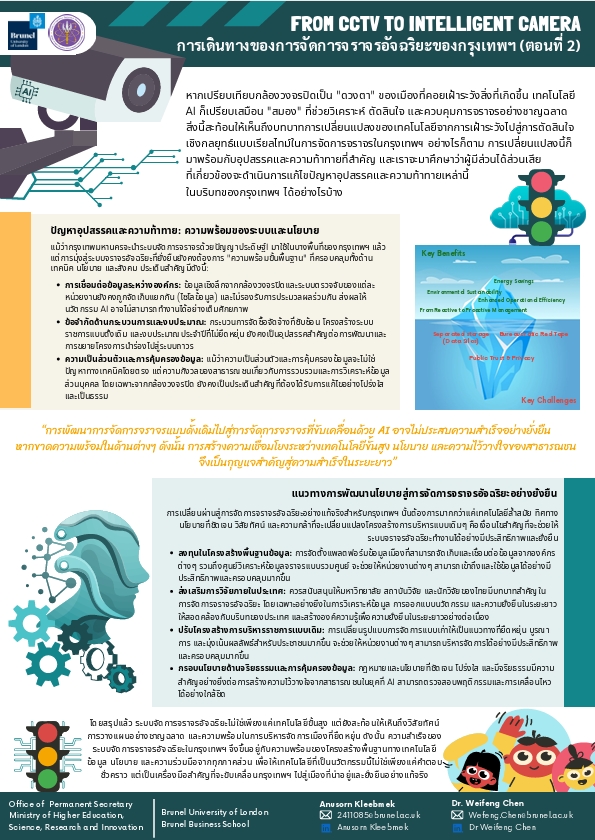
หากเปรียบเทียบกล้องวงจรปิดเป็น "ดวงตา" ของเมืองที่คอยเฝ้าระวังสิ่งที่เกิดขึ้น เทคโนโลยี AI ก็เปรียบเสมือน "สมอง" ที่ช่วยวิเคราะห์ ตัดสินใจ และควบคุมการจราจรอย่างชาญฉลาด สิ่งนี้สะท้อนให้เห็นถึงบทบาทการเปลี่ยนแปลงของเทคโนโลยีจากการเฝ้าระวังไปสู่การตัดสินใจเชิงกลยุทธ์แบบเรียลไทม์ในการจัดการจราจรในกรุงเทพฯ อย่างไรก็ตาม การเปลี่ยนแปลงนี้ก็มาพร้อมกับอุปสรรคและความท้าทายที่สำคัญ และเราจะมาศึกษาว่าผู้มีส่วนได้ส่วนเสียที่เกี่ยวข้องจะดำเนินการแก้ไขปัญหาอุปสรรคและความท้าทายเหล่านี้ในบริบทของกรุงเทพฯ ได้อย่างไรบ้าง


ปัญหาอุปสรรคและความท้าทาย: ความพร้อมของระบบและนโยบาย

แม้ว่ากรุงเทพมหานครจะนำระบบจัดการจราจรด้วยปัญญาประดิษฐ์I มาใช้ในบางพื้นที่ของกรุงเทพฯ แล้ว แต่การมุ่งสู่ระบบจราจรอัจฉริยะที่ยั่งยืนยังคงต้องการ "ความพร้อมขั้นพื้นฐาน" ที่ครอบคลุมทั้งด้านเทคนิค นโยบาย และสังคม ประเด็นสำคัญมีดังนี้:

  • การเชื่อมต่อข้อมูลระหว่างองค์กร: ข้อมูลเชิงลึกจากกล้องวงจรปิดและระบบตรวจจับของแต่ละหน่วยงานยังคงถูกจัดเก็บแยกกัน (ไซโลข้อมูล) และไม่รองรับการประมวลผลร่วมกัน ส่งผลให้ นวัตกรรม AI อาจไม่สามารถทำงานได้อย่างเต็มศักยภาพ
  • ข้อจำกัดด้านกระบวนการและงบประมาณ: กระบวนการจัดซื้อจัดจ้างที่ซับซ้อน โครงสร้างระบบราชการแบบดั้งเดิม และงบประมาณประจำปีที่ไม่ยืดหยุ่น ยังคงเป็นอุปสรรคสำคัญต่อการพัฒนาและการขยายโครงการนำร่องไปสู่ระบบถาวร
  • ความเป็นส่วนตัวและการคุ้มครองข้อมูล: แม้ว่าความเป็นส่วนตัวและการคุ้มครองข้อมูลจะไม่ใช่ปัญหาทางเทคนิคโดยตรง แต่ความกังวลของสาธารณชนเกี่ยวกับการรวบรวมและการวิเคราะห์ข้อมูลส่วนบุคคล โดยเฉพาะจากกล้องวงจรปิด ยังคงเป็นประเด็นสำคัญที่ต้องได้รับการแก้ไขอย่างโปร่งใสและเป็นธรรม

“การพัฒนาการจัดการจราจรแบบดั้งเดิมไปสู่การจัดการจราจรที่ขับเคลื่อนด้วย AI อาจไม่ประสบความสำเร็จอย่างยั่งยืน หากขาดความพร้อมในด้านต่างๆ ดังนั้น การสร้างความเชื่อมโยงระหว่างเทคโนโลยีขั้นสูง นโยบาย และความไว้วางใจของสาธารณชน จึงเป็นกุญแจสำคัญสู่ความสำเร็จในระยะยาว”

ข้อเสนอแนะสำหรับการพัฒนานโยบายสู่การจัดการจราจรอัจฉริยะอย่างยั่งยืน

การเปลี่ยนผ่านสู่การจัดการจราจรอัจฉริยะอย่างแท้จริงสำหรับกรุงเทพฯ นั้นต้องการมากกว่าแค่เทคโนโลยีล้ำสมัย ทิศทางนโยบายที่ชัดเจน วิสัยทัศน์ และความกล้าที่จะเปลี่ยนแปลงโครงสร้างการบริหารแบบเดิม คือเงื่อนไขสำคัญที่จะช่วยให้ระบบจราจรอัจฉริยะทำงานได้อย่างมีประสิทธิภาพและยั่งยืน

  • ลงทุนในโครงสร้างพื้นฐานข้อมูล: การจัดตั้งแพลตฟอร์มข้อมูลเมืองที่สามารถจัดเก็บและเชื่อมต่อข้อมูลจากองค์กรต่างๆ รวมถึงศูนย์วิเคราะห์ข้อมูลจราจรแบบรวมศูนย์ จะช่วยให้หน่วยงานต่างๆ สามารถเข้าถึงและใช้ข้อมูลได้อย่างมีประสิทธิภาพและครอบคลุมมากขึ้น
  • ส่งเสริมการวิจัยภายในประเทศ: ควรสนับสนุนให้มหาวิทยาลัย สถาบันวิจัย และนักวิจัยของไทยมีบทบาทสำคัญในการจัดการจราจรอัจฉริยะ โดยเฉพาะอย่างยิ่งในการวิเคราะห์ข้อมูล การออกแบบนวัตกรรม และความยั่งยืนในระยะยาว ให้สอดคล้องกับบริบทของประเทศ และสร้างองค์ความรู้เพื่อความยั่งยืนในระยะยาวอย่างต่อเนื่อง
  • ปรับโครงสร้างการบริหารราชการแบบเดิม: การเปลี่ยนรูปแบบการจัดการแบบเก่าให้เป็นแนวทางที่ยืดหยุ่น บูรณาการ และมุ่งเน้นผลลัพธ์สำหรับประชาชนมากขึ้น จะช่วยให้หน่วยงานต่างๆ สามารถบริหารจัดการได้อย่างมีประสิทธิภาพและครอบคลุมมากขึ้น
  • กรอบนโยบายด้านจริยธรรมและการคุ้มครองข้อมูล: กฎหมายและนโยบายที่ชัดเจน โปร่งใส และมีจริยธรรมมีความสำคัญอย่างยิ่งต่อการสร้างความไว้วางใจจากสาธารณชนในยุคที่ AI สามารถตรวจสอบพฤติกรรมและการเคลื่อนไหวได้อย่างใกล้ชิด

โดยสรุปแล้ว ระบบจัดการจราจรอัจฉริยะไม่ใช่เพียงแค่เทคโนโลยีขั้นสูง แต่ยังสะท้อนให้เห็นถึงวิสัยทัศน์ การวางแผนอย่างชาญฉลาด และความพร้อมในการบริหารจัดการเมืองที่ยืดหยุ่น ดังนั้น ความสำเร็จของระบบจัดการจราจรอัจฉริยะในกรุงเทพฯ จึงขึ้นอยู่กับความพร้อมของโครงสร้างพื้นฐานทางเทคโนโลยี ข้อมูล นโยบาย และความร่วมมือจากทุกภาคส่วน เพื่อให้เทคโนโลยีที่เป็นนวัตกรรมนี้ไม่ใช่เพียงแค่คำตอบชั่วคราว แต่เป็นเครื่องมือสำคัญที่จะขับเคลื่อนกรุงเทพฯ ไปสู่เมืองที่น่าอยู่และยั่งยืนอย่างแท้จริง


From CCTV to Intelligent Camera: Bangkok's Journey to Intelligent Traffic Management (Part 2)

If CCTV is compared to the "eyes" of the city for surveilling what is occurring, AI technology acts as the "brain", helping analyse, decide, and control traffic intelligently. This reflects the transformational role of technology from surveillance to real-time strategic decision-making. However, this transformation also comes with significant challenges, and we will explore how relevant stakeholders can overcome them in the Bangkok context.

Key Challenges: System Readiness and Policy

While the BMA has already introduced AI-powered traffic management in some areas across Bangkok, steering towards a sustainable intelligent traffic system still requires “fundamental readiness” that covers technical, policy, and societal aspects. The key considerations are as follows:

- Data connection among organisations: The insights from CCTV and detection systems of each agency are still stored separately (data silos), and do not support joint processing. As a result, AI innovation may not be able to operate at its full potential.

- Process and budget limitations: Complex procurement processes, traditional bureaucratic structures, and inflexible annual budgets remain key obstacles to the development and scaling of pilot projects into permanent systems.

- Privacy and data protection: While privacy and data protection are not direct technical hindrances, public concerns regarding the collection and analysis of personal data, particularly from CCTV cameras, remain crucial issues that must be addressed transparently and fairly.

The development of conventional traffic management towards AI-driven traffic management may not sustainably succeed without readiness in all aspects. Thus, building a connection between advanced technology, policy, and public trust is a vital key to long-term success.

Towards Intelligent Traffic Management: Recommendations for Policy Development

The transition to genuine intelligent traffic management for Bangkok requires more than just cutting-edge technology. Clearly defined policy directions, foresight, and the courage to transform conventional administrative structures are the essential conditions that will facilitate the smart traffic system to operate efficiently and sustainably.

- Invest in fundamental data infrastructure: The establishment of an urban data platform that can store and connect data from different organisations, including a centralised traffic data analysis centre, will enable government agencies and authorised parties to access and utilise the data effectively.

- Promote domestic research: Thai universities, research institutions, and researchers should be encouraged to play a significant role in intelligent traffic management systems, particularly in data analysis, innovation design, and long-term sustainability, aligning with the country's context, and continually building on knowledge for long-term sustainability.

- Reconfigure traditional bureaucratic administration: Transforming the old management model into a more resilient, integrated, and results-oriented approach for citizens will enable authorities to administer more effectively and comprehensively.

- Ethical and data protection policy framework: Clear, transparent, and ethical laws and policies are crucial to building public trust in an era where AI can closely monitor behavior and movement.

To sum up, the intelligent traffic management system is not only an advanced technology but also a reflection of visionary thinking, smart planning, and readiness for adaptable urban governance. Therefore, how far the intelligent traffic management system in Bangkok will be able to journey depends on the readiness of technological infrastructure, data, policy, and cooperation from all sectors, so that this innovative technology is not merely a temporary answer but becomes an important tool that can drive Bangkok towards a truly livable and sustainable city.

References

Asad, B., Saxena, N. & Katos, V., 2020. Analysis of the security and privacy risks and challenges in smart cities’ traffic light system. Stevenage, UK, The Institution of Engineering and Technology.

Choosakun, A., Chaiittipornwong, Y. & Yeom, C., 2021. Development of the Cooperative Intelligent Transport System in Thailand: A Prospective Approach. Infrastructures, 6(36), pp. 1-11.

Google Thailand, 2025. BMA partners with Google’s Project Green Light to improve Bangkok traffic with AI-powered signal optimization. [Online] Available at: https://thailand.googleblog.com/2025/05/project-green-light.html [Accessed 31 May 2025].

Kattel, R., Haverkamp, K., Kalema, N. & Kofler, J., 2023. New public management and innovation policy: A systematic literature review. pp. 1-21.

Leo, C. D., 2024. The Role of CCTV Cameras in Traffic and Transportation Safety. [Online] Available at: https://www.spottersecurity.com/blog/cctv-cameras-traffic-and-transportation/ [Accessed 25 May 2025].

Moe, C. E. & Päivärinta, T., 2013. Challenges In Information Systems Procurement in the Public Sector. Electronic Journal of e-Government, 11(2), pp. 308-323.

Morgan, L., 2025. How Data Silos Impact AI and Agents. [Online] Available at: https://www.informationweek.com/machine-learning-ai/how-data-silos-impact-ai-and-agents [Accessed 23 May 2025].

Nigam, N., Singh, D. P. & Choudhary, J., 2023. A Review of Different Components of the Intelligent Traffic Management System (ITMS). Symmetry, 25(3), p. 583.

Profound Logic, 2025. How Government Agencies Are Breaking Down Data Silos with AI. [Online] Available at: https://www.profoundlogic.com/breaking-down-government-data-silos-with-profound-ai/ [Accessed 25 May 2025].

Sivapong, 2024. Implementing the "Ratchaprasong Model" for traffic solutions: Testing intelligent AI to pinpoint violations.. [Online] Available at: https://pr-bangkok.com/?p=283212 [Accessed 25 May 2025].

Smart Transport Strategy for Thailand 4.0 (SmarTran4T4), 2025. Goals as an international collaborative research project. [Online] Available at: https://thailand40.prsvr.net/en/aims-of-this-project/ [Accessed June 4 2025].

Teece, D. J., 2007. Explicating dynamic capabilities: The nature and microfoundations of (sustainable) enterprise performance. Strategic Management Journal, 28(13), pp. 1319-1350.

Wirtz, B. W., Weyerer, J. C. & Kehl, I., 2022. Governance of artificial intelligence: A risk and guideline-based integrative framework. Government Information Quarterly, 39(4), p. 101685.
บทความ "From CCTV to Intelligent Cameras: การเดินทางของการจัดการ จราจรอัจฉริยะของกรุงเทพฯ" (ตอนที่ 1/2)
บทความ "From CCTV to Intelligent Cameras: การเดินทางของการจัดการ จราจรอัจฉริยะของกรุงเทพฯ"

จาก CCTV สู่กล้องอัจฉริยะ: การเดินทางของการจัดการจราจรอัจฉริยะของกรุงเทพฯ (ตอนที่ 1)

ตลอดระยะเวลาหลายทศวรรษที่ผ่านมา กล้อง CCTV ได้กลายเป็นเทคโนโลยีสำคัญในการจัดการจราจรของกรุงเทพฯ ทำหน้าที่เป็นทั้งเครื่องมือเฝ้าระวัง และอำนวยความสะดวกในการจัดการจราจร รวมถึงเพิ่มความปลอดภัยบนท้องถนน ซึ่งเราจะคุ้นเคยกับกล้อง CCTV เหล่านี้เป็นอย่างดี ในการทำหน้าที่บันทึกการเคลื่อนไหวทั้งหมดของเมืองอย่างต่อเนื่องได้เกือบทุกแยกทั่วเมือง ระบบเหล่านี้ช่วยให้ตำรวจจราจร เจ้าหน้าที่กรุงเทพมหานคร และหน่วยงานบังคับใช้กฎหมายสามารถประเมินและตอบสนองต่อเหตุการณ์ได้อย่างมีประสิทธิภาพมากขึ้น ช่วยให้พวกเขาเข้าใจว่าเหตุการณ์เกิดขึ้นเมื่อใด ที่ไหน และอย่างไร ความสามารถเหล่านี้ยังถูกเปรียบเหมือนเป็น "ดวงตา" ของเมืองที่คอยสังเกตการณ์อย่างเงียบๆ มากกว่าที่จะเข้าใจหรือคาดการณ์สิ่งที่กำลังจะเกิดขึ้น ในยุคปัจจุบันที่เทคโนโลยีมีการพัฒนาอย่างรวดเร็ว คำถามสำคัญจึงเกิดขึ้น—CCTV ควรทำหน้าที่เป็นเพียงผู้สังเกตการณ์แบบเดิมหรือไม่ หรือถึงเวลาแล้วหรือยังที่กรุงเทพฯ จะต้องพัฒนา "สมอง"—ระบบที่สามารถคิด วิเคราะห์ และตัดสินใจได้อย่างอิสระ

การเปลี่ยนผ่านการจัดการจราจรของกรุงเทพฯ จากการเฝ้าระวังด้วยกล้อง CCTV แบบเดิมไปสู่ระบบจราจรแบบเรียลไทม์ที่ขับเคลื่อนด้วยเทคโนโลยี AI ชี้ให้เห็นถึงขั้นตอนสำคัญในการเปลี่ยนผ่านไปสู่การจัดการจราจร "อัจฉริยะ" และการเปลี่ยนแปลงครั้งนี้จึงไม่ใช่แค่การเปลี่ยนเทคโนโลยี แต่ต้องมีการกำกับดูแลที่เข้มแข็ง ความร่วมมือระหว่างหน่วยงาน และกรอบนโยบายที่สร้างสรรค์ควบคู่ไปกับการเปลี่ยนแปลงครั้งนี้ด้วย

กล้องวงจรปิดและการจัดการจราจรแบบเชิงรับ

กรุงเทพฯ ใช้กล้องวงจรปิดในการตรวจสอบสภาพการจราจรและบันทึกเหตุการณ์มานานกว่าสองทศวรรษ กล้องเหล่านี้กลายเป็นส่วนหนึ่งของทางแยก จุดกลับรถ และถนนสายหลักทั่วเมือง โดยมีเป้าหมายหลักคือการเพิ่มความปลอดภัยและช่วยให้เจ้าหน้าที่สามารถตรวจสอบเหตุการณ์ได้อย่างรวดเร็ว โดยเฉพาะอย่างยิ่งเมื่อเกิดอุบัติเหตุหรือสถานการณ์ผิดปกติ เป็นต้น ในแง่ของการควบคุมการจราจร ระบบกล้องวงจรปิดแบบดั้งเดิมสามารถสังเกตและบันทึกได้เท่านั้น—ไม่สามารถเข้าไปแทรกแซงหรือปรับเปลี่ยนการบริหารจัดการจราจรแบบเรียลไทม์ได้

ข้อจำกัดที่สำคัญอีกประการหนึ่งก็คือการขาดการบูรณาการข้อมูลแบบเรียลไทม์ ข้อมูลที่รวบรวมจากกล้องวงจรปิดไม่ได้ถูกประมวลผลแบบเรียลไทม์และยังคงถูกจัดเก็บแยกกัน (Silo) โดยหน่วยงานภาครัฐต่างๆ ขาดการบูรณาการหรือการเชื่อมโยงข้อมูลที่มีประสิทธิภาพระหว่างหน่วยงาน ดังนั้นการจัดการจราจรประเภทนี้จึงยังคงเป็นการตอบสนองแบบ "เชิงรับ" ซึ่งหมายถึงการรอให้ปัญหาหรือเหตุการณ์ต่าง ๆ เกิดขึ้นก่อนจึงจะสามารถเข้าไปดำเนินการแก้ไข แทนที่จะสามารถคาดการณ์ ป้องกัน หรือจัดการล่วงหน้าได้ นี่คือเหตุผลว่าทำไมจึงมีกล้องวงจรปิดจำนวนมากทั่วกรุงเทพฯ แต่ปัญหาการจราจรติดขัดในช่วงชั่วโมงเร่งด่วนก็ยังคงเกิดขึ้นซ้ำแล้วซ้ำเล่าโดยไม่มีทีท่าว่าจะดีขึ้น

การเปลี่ยนแปลง: AI กับ "สมองของเมือง"

รัฐบาล นำโดยกรุงเทพมหานครได้ตระหนักถึงปัญหาและข้อจำกัดต่างๆ ของการจัดการจราจรของกรุงเทพฯ และมองว่า ระบบกล้องวงจรปิดแบบเดิมที่คอยสังเกตและบันทึกเหตุการณ์จึงไม่สามารถตอบสนองได้อย่างมีประสิทธิภาพเหมือนแต่ก่อน ดังนั้น เพื่อเพิ่มประสิทธิภาพการจัดการจราจร จึงได้นำเทคโนโลยี AI ที่มีขีดความสามารถในการเรียนรู้และประมวลผลข้อมูลแบบเรียลไทม์มาใช้ ทำให้การจัดการจราจรด้วย AI สามารถคาดการณ์ความแออัดของการจราจร ปรับสัญญาณไฟจราจรตามสภาพการจราจร และตอบสนองต่อเหตุการณ์ได้อย่างทันท่วงที แต่จะมีข้อจำกัดในด้านความเร็วและความยืดหยุ่น ข้อมูลเชิงลึกที่ได้จากการประมวลผลด้วย AI ยังถูกนำไปใช้ในงานวิเคราะห์เชิงคาดการณ์และระบบทำงานอัตโนมัติ ซึ่งออกแบบมาเพื่อสนับสนุนการจัดการจราจรเชิงรุก แนวทางนี้ถือเป็นปัจจัยสำคัญในการทำให้เมืองมีประสิทธิภาพมากขึ้น กรุงเทพมหานครเองก็ได้ดำเนินการในทิศทางนี้ผ่านโครงการที่น่าสนใจต่างๆ เช่น

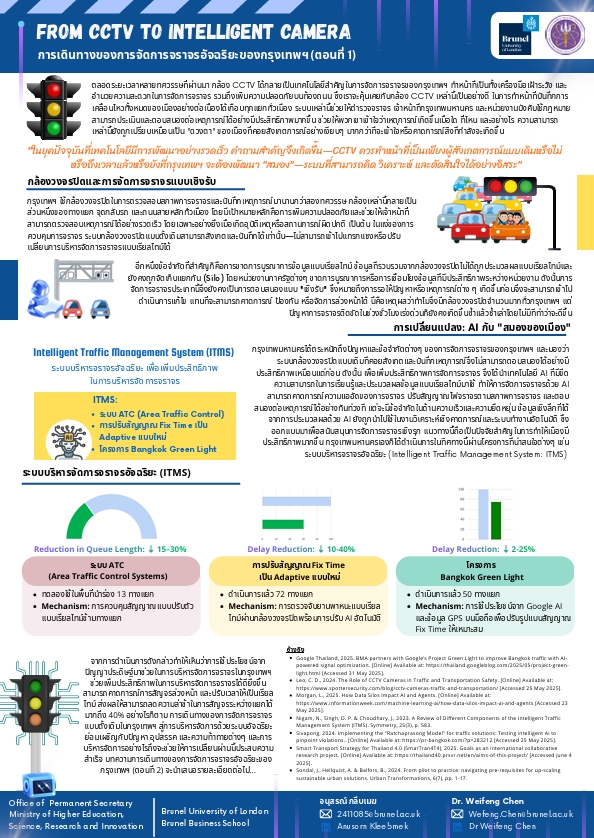
- ระบบจัดการจราจรอัจฉริยะ (ITMS) ซึ่งเป็นโครงการที่ติดตั้งกล้องวงจรปิดที่ขับเคลื่อนด้วยเทคโนโลยี AI นำร่องในแยกที่มีการจราจรติดขัด เช่น ถนนพหลโยธิน ถนนประดิพัทธ์ ถนนพระรามที่ 6 ถนนราชวิถี และถนนนำร่องอื่นๆ ผลการศึกษาแสดงให้เห็นว่าโครงการนี้สามารถช่วยลดความล่าช้าในการเดินทางได้ 10% ในช่วงเวลาเร่งด่วน และ 30% ในช่วงเวลาปกติ

- กรุงเทพมหานครได้ร่วมมือกับ Google ในโครงการไฟเขียว เพื่อแก้ไขปัญหาการจราจรติดขัดในพื้นที่สำคัญต่างๆ ทั่วกรุงเทพฯ โดยเปิดตัวโครงการนี้ในเดือนกุมภาพันธ์ 2568 โครงการนี้ริเริ่มโดย Google ซึ่งใช้เทคโนโลยี AI ร่วมกับข้อมูลการเดินทางจาก Google Maps เพื่อวิเคราะห์รูปแบบการขับขี่ของยานพาหนะ เพื่อให้คำแนะนำที่เหมาะสมในการปรับสัญญาณไฟจราจรให้เหมาะสม นอกจากนี้ การทำงานของระบบยังสามารถลดการหยุดรถที่ไม่จำเป็นและบรรเทาปัญหาการจราจรติดขัด ซึ่งมักทำให้เกิดความล่าช้า และเพิ่มการใช้พลังงาน โครงการนี้ไม่เพียงแต่ช่วยอำนวยความสะดวกในการจัดการจราจรเท่านั้น แต่ยังมุ่งลดการปล่อยก๊าซเรือนกระจกจากยานพาหนะอีกด้วย นี่เป็นอีกวิธีหนึ่งในการยกระดับระบบการจัดการจราจรของกรุงเทพฯ ให้มีความยั่งยืนและเป็นมิตรต่อสิ่งแวดล้อมมากยิ่งขึ้น

จากการดำเนินการดังกล่าวทำให้เห็นว่าการใช้ประโยชน์จากปัญญาประดิษฐ์มาช่วยในการบริหารจัดการจราจรในกรุงเทพฯ ช่วยเพิ่มประสิทธิภาพในการบริหารจัดการจราจรได้ดียิ่งขึ้น สามารถคาดการณ์การสัญจรล่วงหน้า และปรับเวลาให้เป็นเรียลไทม์ ส่งผลให้สามารถลดความล่าช้าในการสัญจรระหว่างแยกได้มากถึง 40% อย่างไรก็ตาม การเดินทางของการจัดการจราจรแบบดั้งเดิมในกรุงเทพฯ สู่การบริหารจัดการด้วยระบบอัจฉริยะ ย่อมเผชิญกับปัญหา อุปสรรค และความท้าทายต่างๆ และการบริหารจัดการอย่างไรถึงจะช่วยให้การเปลี่ยนผ่านนี้ประสบความสำเร็จ บทความการเดินทางของการจัดการจราจรอัจฉริยะของกรุงเทพฯ (ตอนที่ 2) จะนำเสนอรายละเอียดต่อไป...


From CCTV to Intelligent Camera: Bangkok's Journey to Intelligent Traffic Management (Part 1)

Over the decades, CCTV has become a key technology for Bangkok’s traffic management, serving as a surveillance tool to facilitate traffic management and optimise road safety. We can see these CCTVs, which continuously record all movements of the city, at nearly every intersection. These systems allow officials from the Bangkok Metropolitan Administration (BMA) and law enforcement to assess and respond to incidents more efficiently, helping them to understand when, where, and how events occur. However, these abilities still seem like the "eye" of the city that always quietly observes rather than understands or predicts what’s going on next. In an era marked by rapid technological advancement, an important question arises—Should CCTVs serve solely as passive observers? Or is it time for Bangkok to develop a "brain"—a system that can think, analyse, and make decisions autonomously?

The evolution from passive CCTV surveillance to real-time, AI-powered traffic systems signals a necessary step toward “smart traffic” management. However, this transformation demands more than technology—it requires strong governance, inter-agency collaboration, and innovative policy frameworks.

CCTV and Passive Traffic Management

Bangkok has leveraged CCTV cameras to monitor traffic conditions and document incidents for over two decades. These cameras become a part of intersections, U-turn points, and main roads throughout the city, with the primary goal of increasing safety and allowing officers to quickly investigate incidents, specifically when accidents or unusual situations occur. Nevertheless, in terms of traffic control, traditional CCTV systems can only observe and record—they are not equipped to intervene or adjust traffic dynamics in real time.

Another key constraint is the absence of real-time data integration. Information collected from CCTVs is not processed in real time and is still stored separately by various public agencies, lacking effective integration or linking of data across agencies. Hence, this type of traffic management is still a "reactive" response, which means waiting for problems or difficulties to happen before taking action to address them, rather than being able to predict, prevent, or manage in advance. These are the reasons there are so many cameras throughout Bangkok, yet rush-hour traffic congestion continues to recur with no sign of improvement.

Transformation: AI with the "brain of the cities"

As the city continually expands, the complexity of traffic systems will also increase; consequently, to optimise traffic management, the conventional CCTV systems that observe and record incidents can no longer provide the effective responses they once did. The implementation of AI technology with advanced learning and processing capabilities for real-time data enables AI-powered traffic management to predict traffic congestion, adjust traffic signals according to traffic conditions, and respond promptly to incidents. All of this is carried out by intelligent systems that continuously learn and process without relying on conventional traffic control, which has limitations in terms of speed and resilience. The insights derived from AI processing are also being used in predictive analytics and automated workflows, which are designed to support proactive traffic management. This approach is seen as a significant factor in making cities more efficient. Bangkok Metropolitan Administration (BMA) itself has also executed in this direction through various interesting projects, such as

- Intelligent Traffic Management System (ITMS), which is a scheme where AI-driven CCTV is installed at 13 intersections with congested traffic conditions, such as Phaholyothin Road, Pradiphat Road, Rama VI Road, and Ratchawithi Road. The result illustrated that the project reduced travel delays by 10% during peak times and by 30% during off-peak hours.

- The BMA has collaborated with Google on the Green Light Project to address severe traffic congestion issues in key areas across Bangkok, launching this project in February 2025. This project was initiated by Google, which harnesses AI technology in conjunction with Google Maps travel data to analyse vehicle driving patterns to provide appropriate advice to optimise the adjustment of traffic signals. Also, the system’s operation can reduce unnecessary stops and alleviate stop-and-go traffic, which often causes delays and increases energy consumption. This project not only facilitates traffic management but also aims to reduce greenhouse gas emissions from vehicles. This is another way to elevate Bangkok’s traffic management system to be more sustainable and environmentally friendly.

If CCTV is compared to the "eyes" of the cities to surveil what is occurring, AI technology acts as the "brain," helping analyse, decide, and control traffic intelligently. This reflects the transformational role of technology from surveillance to real-time strategic decision-making.

References

Google Thailand, 2025. BMA partners with Google’s Project Green Light to improve Bangkok traffic with AI-powered signal optimization. [Online] Available at: https://thailand.googleblog.com/2025/05/project-green-light.html [Accessed 31 May 2025].

Leo, C. D., 2024. The Role of CCTV Cameras in Traffic and Transportation Safety. [Online] Available at: https://www.spottersecurity.com/blog/cctv-cameras-traffic-and-transportation/ [Accessed 25 May 2025].

Morgan, L., 2025. How Data Silos Impact AI and Agents. [Online] Available at: https://www.informationweek.com/machine-learning-ai/how-data-silos-impact-ai-and-agents [Accessed 23 May 2025].

Nigam, N., Singh, D. P. & Choudhary, J., 2023. A Review of Different Components of the Intelligent Traffic Management System (ITMS). Symmetry, 25(3), p. 583.

Sivapong, 2024. Implementing the "Ratchaprasong Model" for traffic solutions: Testing intelligent AI to pinpoint violations.. [Online] Available at: https://pr-bangkok.com/?p=283212 [Accessed 25 May 2025].

Smart Transport Strategy for Thailand 4.0 (SmarTran4T4), 2025. Goals as an international collaborative research project. [Online] Available at: https://thailand40.prsvr.net/en/aims-of-this-project/ [Accessed June 4 2025].

Sondal, J., Hellquist, A. & Balfors, B., 2024. From pilot to practice: navigating pre-requisites for up-scaling sustainable urban solutions. Urban Transformations, 6(7), pp. 1-17.

เว็บไซต์นี้ เป็นเว็บไซต์หน่วยงานของรัฐในสังกัดสำนักงานปลัดกระทรวง กระทรวงการอุดมศึกษา วิทยาศาสตร์ วิจัยและนวัตกรรม จัดตั้งขึ้นเพื่อมุ่งมั่นพัฒนาคุณภาพการบริหารจัดการ สป.อว. เพื่อเข้าสู่มาตรฐานการบริหารจัดการภาครัฐ ไม่ได้มีวัตถุประสงค์เพื่อแสวงหากำไร หากท่านพบว่ามีข้อมูลใดๆ ที่ละเมิดทรัพย์สินทางปัญญาปรากฏอยู่ในเว็บไซต์ของสำนักงานปลัดกระทรวง โปรดแจ้งให้ทราบเพื่อดำเนินการแก้ปัญหาดังกล่าวโดยเร็วที่สุดต่อไป

ISO 27001 Audit Certification  ISO 27001:2013 Bureau Veritas Certification UK Limited  AlphaSSL CA - SHA256 - G4   WCAG 2.0 (Level AAA)