
บทความ "From CCTV to Intelligent Cameras: การเดินทางของการจัดการ จราจรอัจฉริยะของกรุงเทพฯ" (ตอนที่ 2/2)
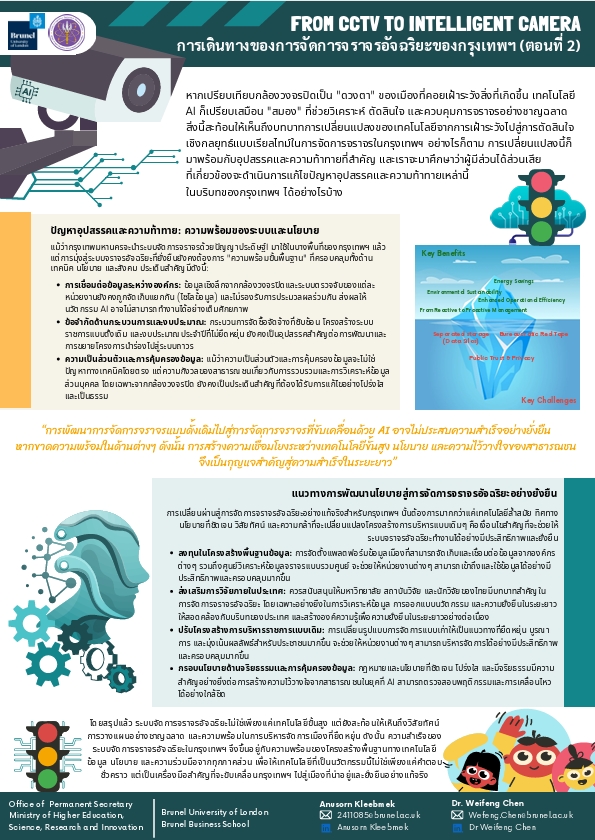 บทความ "From CCTV to Intelligent Cameras: การเดินทางของการจัดการ จราจรอัจฉริยะของกรุงเทพฯ" (ตอนที่ 2/2)
หากเปรียบเทียบกล้องวงจรปิดเป็น "ดวงตา" ของเมืองที่คอยเฝ้าระวังสิ่งที่เกิดขึ้น เทคโนโลยี AI ก็เปรียบเสมือน "สมอง" ที่ช่วยวิเคราะห์ ตัดสินใจ และควบคุมการจราจรอย่างชาญฉลาด สิ่งนี้สะท้อนให้เห็นถึงบทบาทการเปลี่ยนแปลงของเทคโนโลยีจากการเฝ้าระวังไปสู่การตัดสินใจเชิงกลยุทธ์แบบเรียลไทม์ในการจัดการจราจรในกรุงเทพฯ อย่างไรก็ตาม การเปลี่ยนแปลงนี้ก็มาพร้อมกับอุปสรรคและความท้าทายที่สำคัญ และเราจะมาศึกษาว่าผู้มีส่วนได้ส่วนเสียที่เกี่ยวข้องจะดำเนินการแก้ไขปัญหาอุปสรรคและความท้าทายเหล่านี้ในบริบทของกรุงเทพฯ ได้อย่างไรบ้าง
ปัญหาอุปสรรคและความท้าทาย: ความพร้อมของระบบและนโยบาย
แม้ว่ากรุงเทพมหานครจะนำระบบจัดการจราจรด้วยปัญญาประดิษฐ์I มาใช้ในบางพื้นที่ของกรุงเทพฯ แล้ว แต่การมุ่งสู่ระบบจราจรอัจฉริยะที่ยั่งยืนยังคงต้องการ "ความพร้อมขั้นพื้นฐาน" ที่ครอบคลุมทั้งด้านเทคนิค นโยบาย และสังคม ประเด็นสำคัญมีดังนี้:
- การเชื่อมต่อข้อมูลระหว่างองค์กร: ข้อมูลเชิงลึกจากกล้องวงจรปิดและระบบตรวจจับของแต่ละหน่วยงานยังคงถูกจัดเก็บแยกกัน (ไซโลข้อมูล) และไม่รองรับการประมวลผลร่วมกัน ส่งผลให้ นวัตกรรม AI อาจไม่สามารถทำงานได้อย่างเต็มศักยภาพ
- ข้อจำกัดด้านกระบวนการและงบประมาณ: กระบวนการจัดซื้อจัดจ้างที่ซับซ้อน โครงสร้างระบบราชการแบบดั้งเดิม และงบประมาณประจำปีที่ไม่ยืดหยุ่น ยังคงเป็นอุปสรรคสำคัญต่อการพัฒนาและการขยายโครงการนำร่องไปสู่ระบบถาวร
- ความเป็นส่วนตัวและการคุ้มครองข้อมูล: แม้ว่าความเป็นส่วนตัวและการคุ้มครองข้อมูลจะไม่ใช่ปัญหาทางเทคนิคโดยตรง แต่ความกังวลของสาธารณชนเกี่ยวกับการรวบรวมและการวิเคราะห์ข้อมูลส่วนบุคคล โดยเฉพาะจากกล้องวงจรปิด ยังคงเป็นประเด็นสำคัญที่ต้องได้รับการแก้ไขอย่างโปร่งใสและเป็นธรรม
“การพัฒนาการจัดการจราจรแบบดั้งเดิมไปสู่การจัดการจราจรที่ขับเคลื่อนด้วย AI อาจไม่ประสบความสำเร็จอย่างยั่งยืน หากขาดความพร้อมในด้านต่างๆ ดังนั้น การสร้างความเชื่อมโยงระหว่างเทคโนโลยีขั้นสูง นโยบาย และความไว้วางใจของสาธารณชน จึงเป็นกุญแจสำคัญสู่ความสำเร็จในระยะยาว”
ข้อเสนอแนะสำหรับการพัฒนานโยบายสู่การจัดการจราจรอัจฉริยะอย่างยั่งยืน
การเปลี่ยนผ่านสู่การจัดการจราจรอัจฉริยะอย่างแท้จริงสำหรับกรุงเทพฯ นั้นต้องการมากกว่าแค่เทคโนโลยีล้ำสมัย ทิศทางนโยบายที่ชัดเจน วิสัยทัศน์ และความกล้าที่จะเปลี่ยนแปลงโครงสร้างการบริหารแบบเดิม คือเงื่อนไขสำคัญที่จะช่วยให้ระบบจราจรอัจฉริยะทำงานได้อย่างมีประสิทธิภาพและยั่งยืน
- ลงทุนในโครงสร้างพื้นฐานข้อมูล: การจัดตั้งแพลตฟอร์มข้อมูลเมืองที่สามารถจัดเก็บและเชื่อมต่อข้อมูลจากองค์กรต่างๆ รวมถึงศูนย์วิเคราะห์ข้อมูลจราจรแบบรวมศูนย์ จะช่วยให้หน่วยงานต่างๆ สามารถเข้าถึงและใช้ข้อมูลได้อย่างมีประสิทธิภาพและครอบคลุมมากขึ้น
- ส่งเสริมการวิจัยภายในประเทศ: ควรสนับสนุนให้มหาวิทยาลัย สถาบันวิจัย และนักวิจัยของไทยมีบทบาทสำคัญในการจัดการจราจรอัจฉริยะ โดยเฉพาะอย่างยิ่งในการวิเคราะห์ข้อมูล การออกแบบนวัตกรรม และความยั่งยืนในระยะยาว ให้สอดคล้องกับบริบทของประเทศ และสร้างองค์ความรู้เพื่อความยั่งยืนในระยะยาวอย่างต่อเนื่อง
- ปรับโครงสร้างการบริหารราชการแบบเดิม: การเปลี่ยนรูปแบบการจัดการแบบเก่าให้เป็นแนวทางที่ยืดหยุ่น บูรณาการ และมุ่งเน้นผลลัพธ์สำหรับประชาชนมากขึ้น จะช่วยให้หน่วยงานต่างๆ สามารถบริหารจัดการได้อย่างมีประสิทธิภาพและครอบคลุมมากขึ้น
- กรอบนโยบายด้านจริยธรรมและการคุ้มครองข้อมูล: กฎหมายและนโยบายที่ชัดเจน โปร่งใส และมีจริยธรรมมีความสำคัญอย่างยิ่งต่อการสร้างความไว้วางใจจากสาธารณชนในยุคที่ AI สามารถตรวจสอบพฤติกรรมและการเคลื่อนไหวได้อย่างใกล้ชิด
โดยสรุปแล้ว ระบบจัดการจราจรอัจฉริยะไม่ใช่เพียงแค่เทคโนโลยีขั้นสูง แต่ยังสะท้อนให้เห็นถึงวิสัยทัศน์ การวางแผนอย่างชาญฉลาด และความพร้อมในการบริหารจัดการเมืองที่ยืดหยุ่น ดังนั้น ความสำเร็จของระบบจัดการจราจรอัจฉริยะในกรุงเทพฯ จึงขึ้นอยู่กับความพร้อมของโครงสร้างพื้นฐานทางเทคโนโลยี ข้อมูล นโยบาย และความร่วมมือจากทุกภาคส่วน เพื่อให้เทคโนโลยีที่เป็นนวัตกรรมนี้ไม่ใช่เพียงแค่คำตอบชั่วคราว แต่เป็นเครื่องมือสำคัญที่จะขับเคลื่อนกรุงเทพฯ ไปสู่เมืองที่น่าอยู่และยั่งยืนอย่างแท้จริง
From CCTV to Intelligent Camera: Bangkok's Journey to Intelligent Traffic Management (Part 2)
If CCTV is compared to the "eyes" of the city for surveilling what is occurring, AI technology acts as the "brain", helping analyse, decide, and control traffic intelligently. This reflects the transformational role of technology from surveillance to real-time strategic decision-making. However, this transformation also comes with significant challenges, and we will explore how relevant stakeholders can overcome them in the Bangkok context.
Key Challenges: System Readiness and Policy
While the BMA has already introduced AI-powered traffic management in some areas across Bangkok, steering towards a sustainable intelligent traffic system still requires “fundamental readiness” that covers technical, policy, and societal aspects. The key considerations are as follows:
- Data connection among organisations: The insights from CCTV and detection systems of each agency are still stored separately (data silos), and do not support joint processing. As a result, AI innovation may not be able to operate at its full potential.
- Process and budget limitations: Complex procurement processes, traditional bureaucratic structures, and inflexible annual budgets remain key obstacles to the development and scaling of pilot projects into permanent systems.
- Privacy and data protection: While privacy and data protection are not direct technical hindrances, public concerns regarding the collection and analysis of personal data, particularly from CCTV cameras, remain crucial issues that must be addressed transparently and fairly.
The development of conventional traffic management towards AI-driven traffic management may not sustainably succeed without readiness in all aspects. Thus, building a connection between advanced technology, policy, and public trust is a vital key to long-term success.
Towards Intelligent Traffic Management: Recommendations for Policy Development
The transition to genuine intelligent traffic management for Bangkok requires more than just cutting-edge technology. Clearly defined policy directions, foresight, and the courage to transform conventional administrative structures are the essential conditions that will facilitate the smart traffic system to operate efficiently and sustainably.
- Invest in fundamental data infrastructure: The establishment of an urban data platform that can store and connect data from different organisations, including a centralised traffic data analysis centre, will enable government agencies and authorised parties to access and utilise the data effectively.
- Promote domestic research: Thai universities, research institutions, and researchers should be encouraged to play a significant role in intelligent traffic management systems, particularly in data analysis, innovation design, and long-term sustainability, aligning with the country's context, and continually building on knowledge for long-term sustainability.
- Reconfigure traditional bureaucratic administration: Transforming the old management model into a more resilient, integrated, and results-oriented approach for citizens will enable authorities to administer more effectively and comprehensively.
- Ethical and data protection policy framework: Clear, transparent, and ethical laws and policies are crucial to building public trust in an era where AI can closely monitor behavior and movement.
To sum up, the intelligent traffic management system is not only an advanced technology but also a reflection of visionary thinking, smart planning, and readiness for adaptable urban governance. Therefore, how far the intelligent traffic management system in Bangkok will be able to journey depends on the readiness of technological infrastructure, data, policy, and cooperation from all sectors, so that this innovative technology is not merely a temporary answer but becomes an important tool that can drive Bangkok towards a truly livable and sustainable city.
References
Asad, B., Saxena, N. & Katos, V., 2020. Analysis of the security and privacy risks and challenges in smart cities’ traffic light system. Stevenage, UK, The Institution of Engineering and Technology.
Choosakun, A., Chaiittipornwong, Y. & Yeom, C., 2021. Development of the Cooperative Intelligent Transport System in Thailand: A Prospective Approach. Infrastructures, 6(36), pp. 1-11.
Google Thailand, 2025. BMA partners with Google’s Project Green Light to improve Bangkok traffic with AI-powered signal optimization. [Online] Available at: https://thailand.googleblog.com/2025/05/project-green-light.html [Accessed 31 May 2025].
Kattel, R., Haverkamp, K., Kalema, N. & Kofler, J., 2023. New public management and innovation policy: A systematic literature review. pp. 1-21.
Leo, C. D., 2024. The Role of CCTV Cameras in Traffic and Transportation Safety. [Online] Available at: https://www.spottersecurity.com/blog/cctv-cameras-traffic-and-transportation/ [Accessed 25 May 2025].
Moe, C. E. & Päivärinta, T., 2013. Challenges In Information Systems Procurement in the Public Sector. Electronic Journal of e-Government, 11(2), pp. 308-323.
Morgan, L., 2025. How Data Silos Impact AI and Agents. [Online] Available at: https://www.informationweek.com/machine-learning-ai/how-data-silos-impact-ai-and-agents [Accessed 23 May 2025].
Nigam, N., Singh, D. P. & Choudhary, J., 2023. A Review of Different Components of the Intelligent Traffic Management System (ITMS). Symmetry, 25(3), p. 583.
Profound Logic, 2025. How Government Agencies Are Breaking Down Data Silos with AI. [Online] Available at: https://www.profoundlogic.com/breaking-down-government-data-silos-with-profound-ai/ [Accessed 25 May 2025].
Sivapong, 2024. Implementing the "Ratchaprasong Model" for traffic solutions: Testing intelligent AI to pinpoint violations.. [Online] Available at: https://pr-bangkok.com/?p=283212 [Accessed 25 May 2025].
Smart Transport Strategy for Thailand 4.0 (SmarTran4T4), 2025. Goals as an international collaborative research project. [Online] Available at: https://thailand40.prsvr.net/en/aims-of-this-project/ [Accessed June 4 2025].
Teece, D. J., 2007. Explicating dynamic capabilities: The nature and microfoundations of (sustainable) enterprise performance. Strategic Management Journal, 28(13), pp. 1319-1350.
Wirtz, B. W., Weyerer, J. C. & Kehl, I., 2022. Governance of artificial intelligence: A risk and guideline-based integrative framework. Government Information Quarterly, 39(4), p. 101685.


